

The Google November 2026 core update started rolling out on November 10.
It is the third core update of the year.
Google says it applies globally and to all languages.
The rollout may take up to two weeks.
Based on my hands-on experience with SEO, I can tell you one thing.
I see the same mistake in the first week of every core update.
Site owners panic and start changing everything on their website.
In this article, I will share what Google has actually confirmed about the Google November 2026 core update.
Then, the things nobody knows yet.
And finally, a simple plan for what you should do starting today.
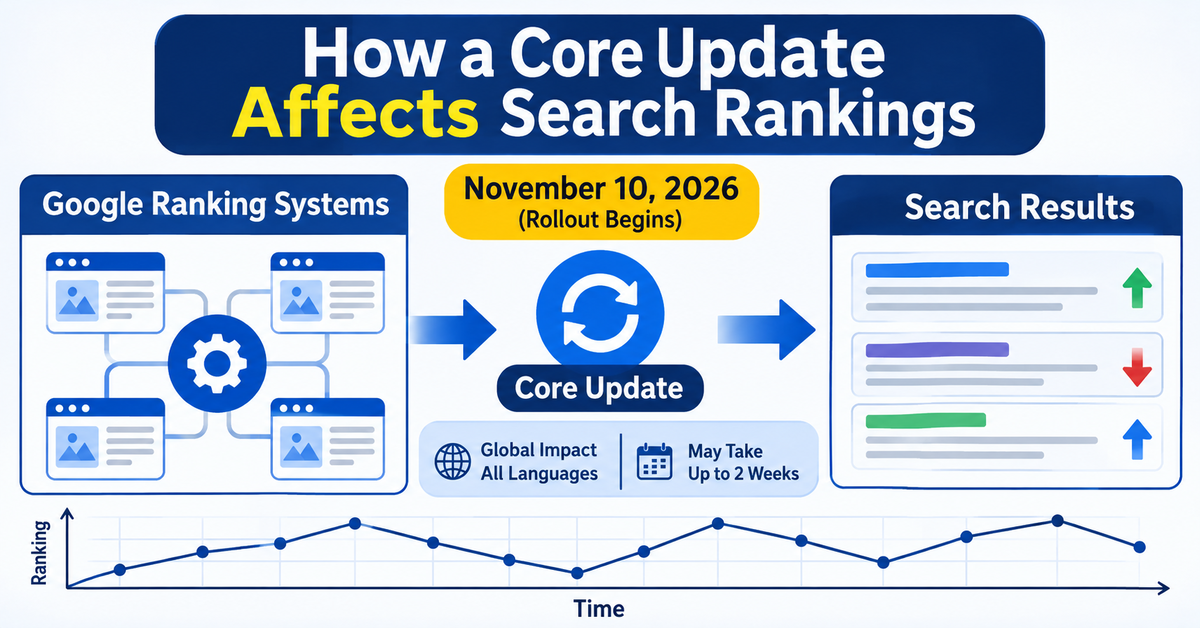
Google November 2026 Core Update Date and Rollout Time
Google announced the update on its Search Status Dashboard.
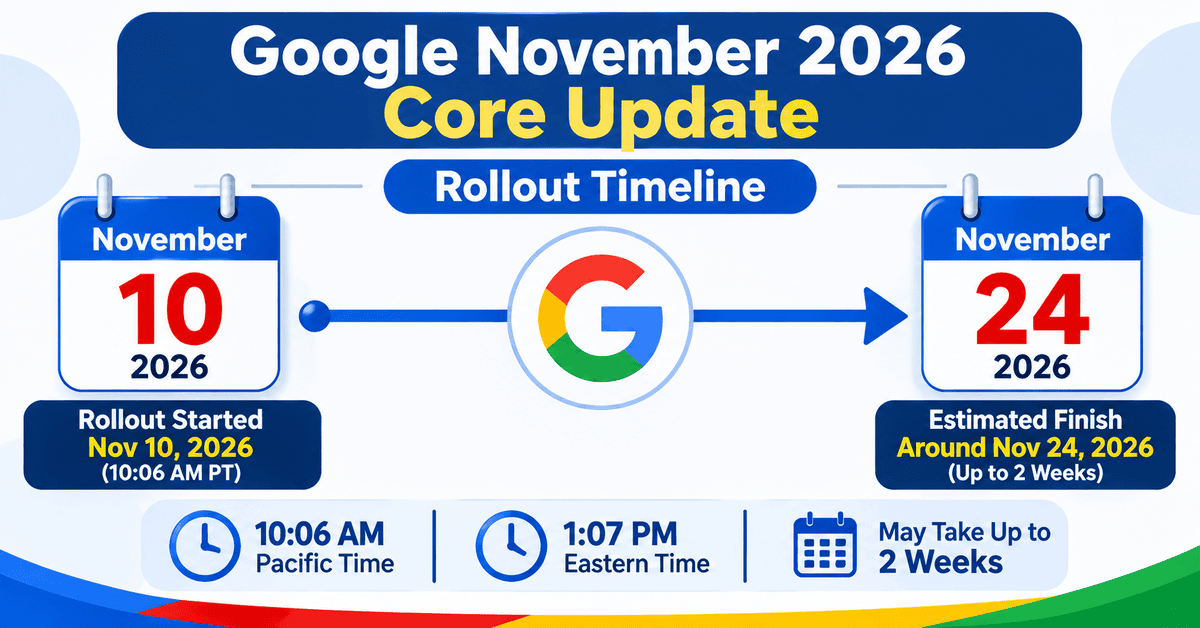
The rollout began on November 10, 2026 at 10:06 AM Pacific Time.
That was 1:07 PM Eastern Time.
Google’s own wording is that the rollout may take up to 2 weeks to complete.
That puts the latest finish date around November 24.
Treat that date as an estimate, not a promise.
The first two core updates of 2026 both finished in under two weeks.
The March 2026 update took about 12 days.
The May 2026 update also took about 12 days.
But the December 2025 update ran for 18 days.
So it is too early to draw conclusions.
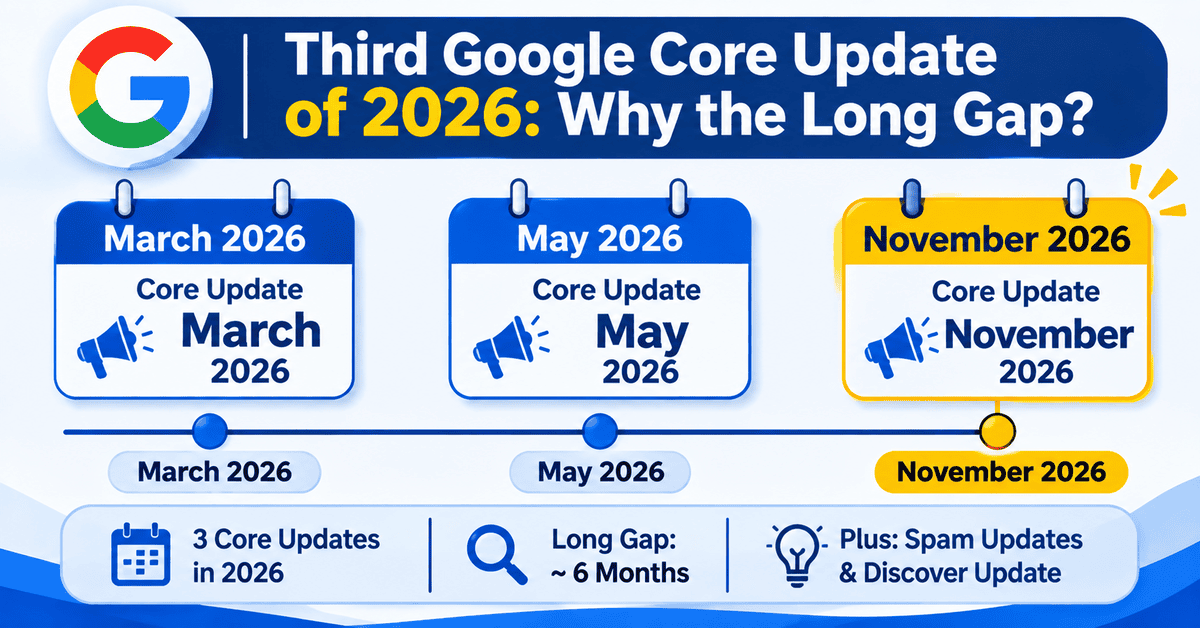
Third Google Core Update of 2026: Why the Long Gap?
There were about six months between the May update and this one.
Many SEOs did not expect an update this week.
Some guessed it would arrive at the end of November or in December.
But ranking volatility had been visible since the start of the month.
Experts like Glenn Gabe had already hinted that a big update could be coming.
So far in 2026, Google has released three core updates:
- March 2026 core update
- May 2026 core update
- November 2026 core update
Google also released several spam updates and a Discover update in between.
Google Core Update History: Dates of Recent Updates
Looking at past dates helps you estimate how long a rollout may last.
- December 2025: December 11 to December 29
- March 2026: March 27 to April 8
- May 2026: May 21 to June 2
- November 2026: started November 10
In my experience, the first three to five days are the most volatile.
Rankings then settle to some degree.
But the real picture only becomes clear after the rollout is finished.
Core Update vs Spam Update: What Is the Difference?
A core update and a spam update are not the same thing.
A core update is a broad change to Google’s ranking systems.
A spam update targets sites that break Google’s spam policies.
When both run at the same time, analysis becomes very hard.
That is why some SEOs asked Google not to overlap them.
Core Update Ranking Volatility: What You May See Right Now
During a core update, rankings move up and down.
That is normal.
Your position may drop today.
It may come back tomorrow.
So do not make big decisions in the middle of a rollout.
One thing people often ignore: rank tracking data can be less reliable during this period.
Do not rely on a single tool.
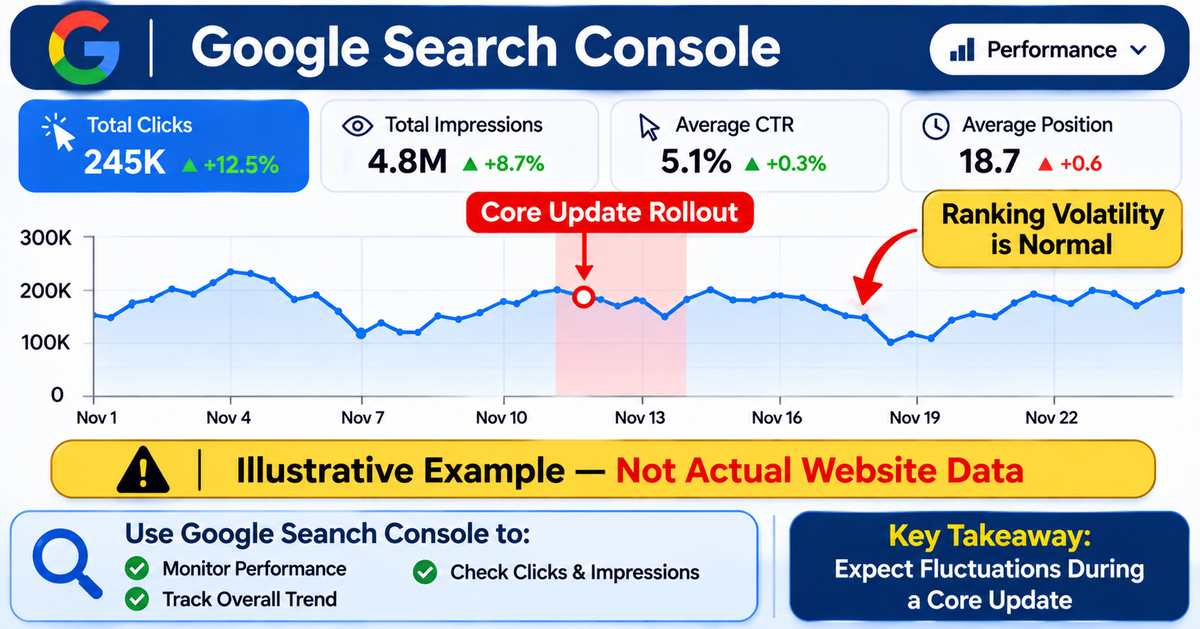
Google Search Console is the most trustworthy source of data.
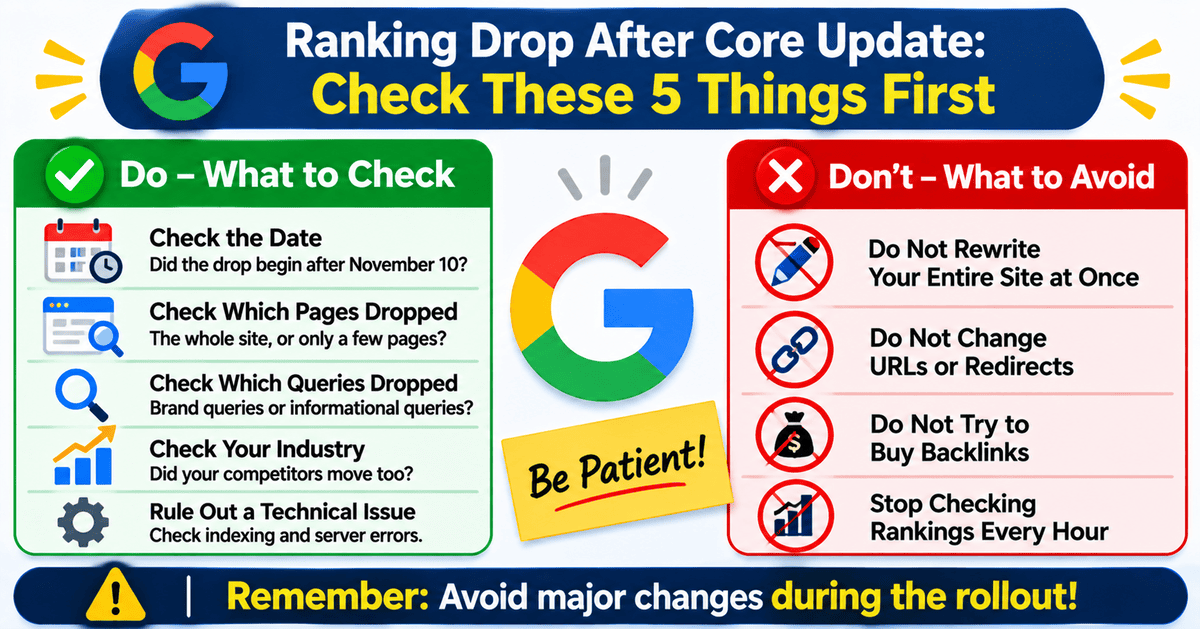
Ranking Drop After Core Update: Check These 5 Things First
If your traffic has dropped, check these before you panic.
- Check the date. Did the drop begin after November 10?
- Check which pages dropped. The whole site, or only a few pages?
- Check which queries dropped. Brand queries or informational queries?
- Check your industry. Did your competitors move too?
- Rule out a technical issue. Check indexing and server errors.
Many people start changing their site on day one.
That is the biggest mistake.
If you change things during the rollout, you cannot tell what caused what.
What Not to Do During the Rollout
- Do not rewrite your entire site at once.
- Do not change URLs or redirects.
- Do not try to buy backlinks.
- Stop checking rankings every hour.
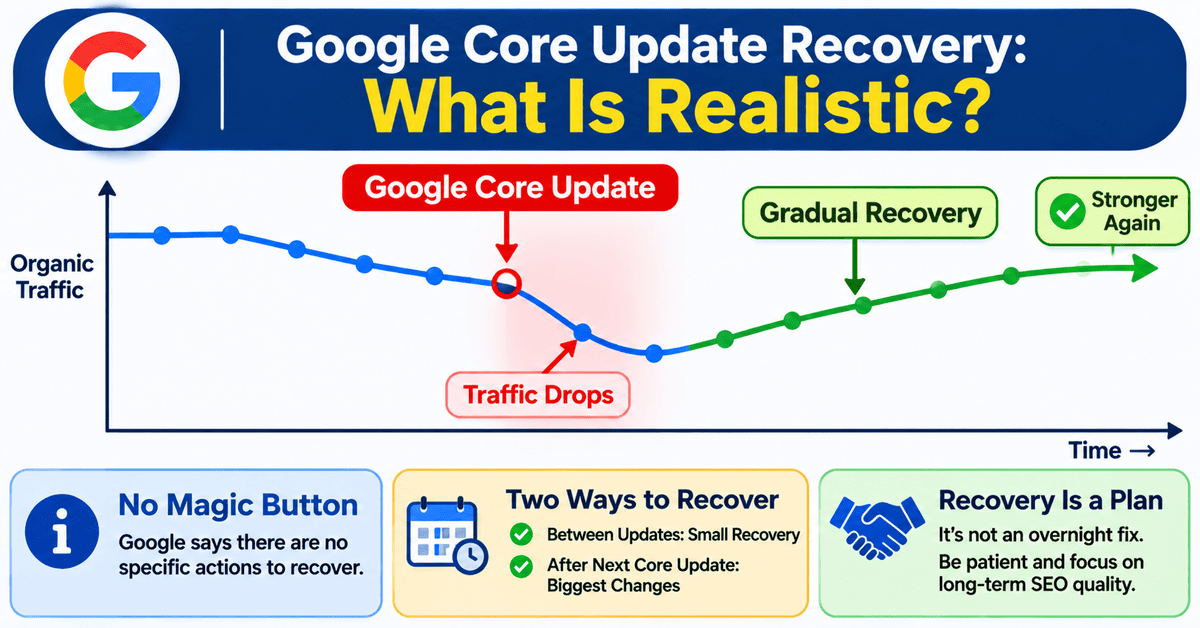
Google Core Update Recovery: What Is Realistic?
The honest truth is that there is no single recovery button after a core update.
Google itself says there are no specific actions you can take to recover.
A drop in rankings does not always mean something is wrong with your pages.
Google may simply have found other pages more relevant.
In my experience, recovery comes in two ways:
- Between updates: You may see a small recovery.
- After the next core update: The biggest changes usually arrive with the following update.
So recovery is a plan, not an overnight fix.
How to Audit Your Pages Honestly
Start with a list of your 10 pages with the most traffic.
For each page, ask these questions:
- Does this page answer what the searcher actually wants?
- Does it only repeat what every other page already says?
- Can a reader see real experience behind it?
- Is any information outdated or wrong?
If the answer to any of these is “no”, that page is where your real work is.
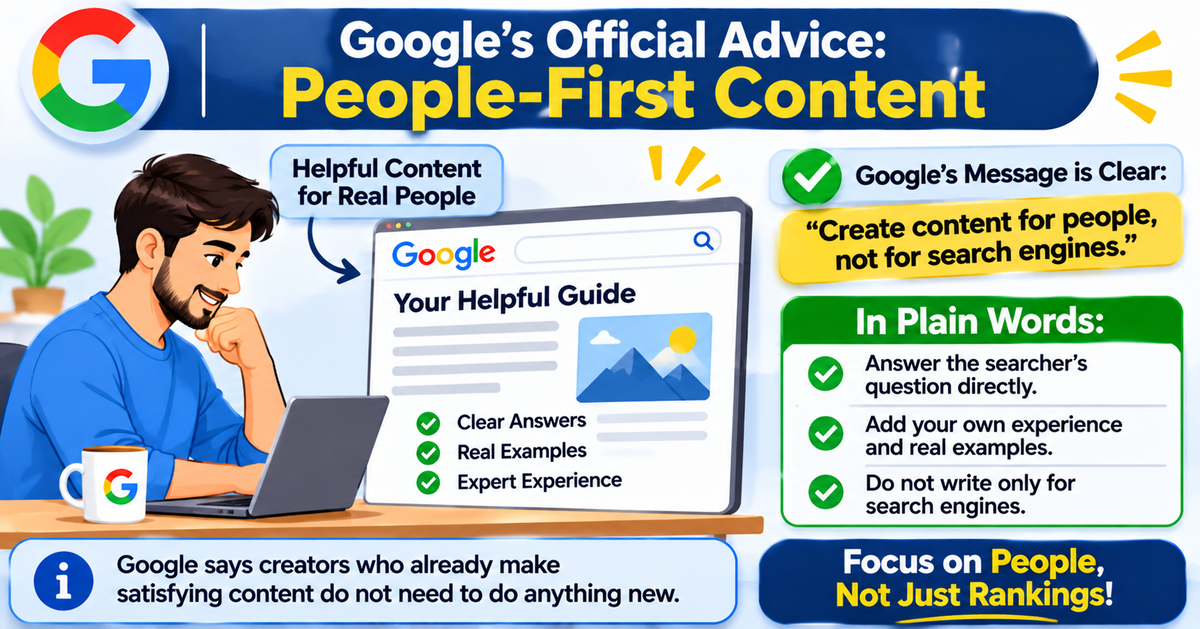
Google’s Official Advice: People-First Content
Google has not shared new guidance specific to this update.
Its earlier advice still stands: create content for people, not for search engines.
Google has said creators who already make satisfying content do not need to do anything new.
It also encourages site owners to read its helpful, reliable, people-first content guidance.
In plain words, that means:
- Answer the searcher’s question directly.
- Add your own experience and real examples.
- Do not write only for search engines.
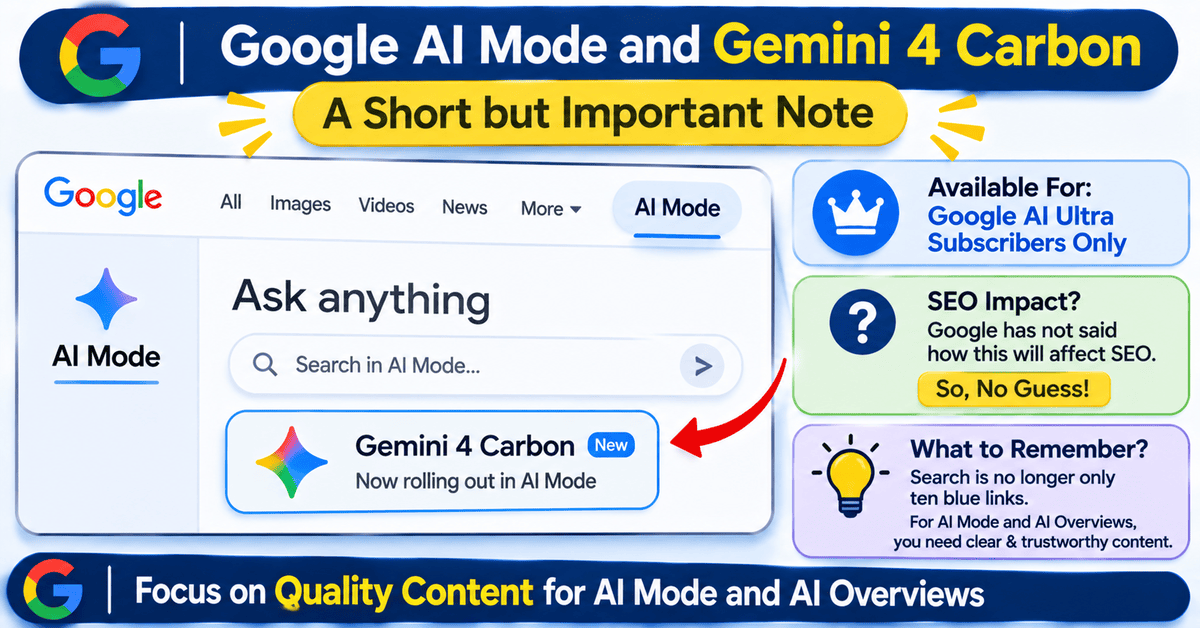
Google AI Mode and Gemini 4 Carbon: A Short but Important Note
On the same day, Google announced something else.
Gemini 4 Carbon, Google’s newest model, started rolling out in AI Mode.
For now, it is only available to Google AI Ultra subscribers.
Google has not said how this will affect SEO.
So I will not guess.
Just remember that search is no longer only ten blue links.
For AI Mode and AI Overviews too, you need content that is clear and trustworthy.
What Is Still Unclear About This Update
A few questions are still open.
- Google has not said which types of sites will gain or lose.
- It has not said whether Discover and AI features are affected too.
- It is not clear whether the rollout will finish inside the two-week window.
I will not fill these gaps with guesses.
Wait for clear data before you draw conclusions.
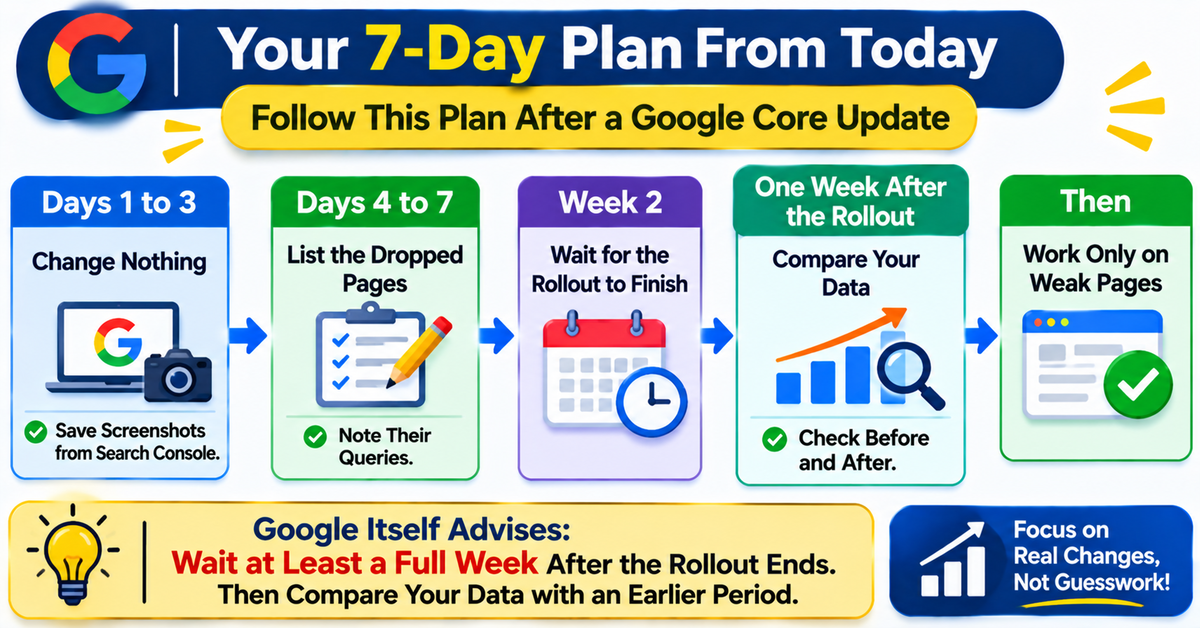
Your 7-Day Plan From Today
This is the plan I give my own clients.
- Days 1 to 3: Change nothing. Save screenshots from Search Console.
- Days 4 to 7: List the pages that dropped and note their queries.
- Week 2: Wait for the rollout to finish.
- One week after the rollout: Compare your data before and after.
- Then: Work only on the pages that are genuinely weak.
Google itself advises waiting at least a full week after the rollout ends.
Then compare your data with an earlier period.
When to Get Help From an SEO Expert
If your traffic has dropped sharply, a professional audit can help.
This matters most when your sales depend on Google.
It is better to have an experienced person review your data than to guess alone.
A good audit looks at technical issues, content quality, and backlinks together.
Grow Your Website With AlphaBL
After a core update, it helps to have a reliable team beside you.
AlphaBL guides businesses in digital marketing and SEO.
If you are in Sialkot, take a look at our seo expert in Sialkot service.
If you are in Lahore, see our SEO services in Lahore page.
We audit your site, find the weak pages, and give you a clear plan.

Final Thoughts
The Google November 2026 core update is still rolling out.
Right now, patience is your biggest advantage.
Do not make big decisions during the rollout.
Save your data and wait for the rollout to finish.
Then work only on the pages that are truly weak.
Instead of fearing the Google November 2026 core update, treat it as a chance to check the quality of your site.
Content written for people is what lasts in the long run.

FAQs: Common Questions About the Google Core Update
What is a Google core update?
A core update is a broad change to Google’s ranking systems.
It happens several times a year.
It does not target any specific site.
When did the Google November 2026 core update start?
It started on November 10, 2026, at 10:06 AM Pacific Time.
Google says the rollout may take up to 2 weeks.
How long does a Google core update take?
Google usually says up to two weeks.
The March and May 2026 updates both finished in about 12 days.
But the December 2025 update took 18 days.
What should I do if my rankings drop after a core update?
First, wait for the rollout to finish.
Then wait at least a week and compare your Search Console data.
After that, work on the quality of the pages that dropped.
Can you recover from a core update?
Google says there are no specific actions that guarantee recovery.
Working on helpful, people-first content can improve your rankings over time.
The biggest changes often come with the next core update.
What is the difference between a core update and a spam update?
A core update is a broad ranking change.
A spam update targets sites that break Google’s spam policies.
How many core updates has Google released in 2026?
The November 2026 update is the third core update of the year.
The first two came in March and May 2026.
Does the Google core update only affect English websites?
No.
Google says it applies globally and to all languages.

Habib Ur Rehman is the Founder and CEO of Alpha BL, specializing in Digital Marketing and SEO.