
If you are comparing ChatGPT vs. Claude for SEO, the advice you read in March 2026 is already out of date.
Both companies released new model families this autumn.
ChatGPT moved to the GPT-6 line, and Claude moved to the 5.5 line.
Some claims in older comparisons, such as “Claude cannot browse the web,” are no longer true.
This guide shows what actually changed, task by task.
It also gives you a workflow you can start using today, written from a practitioner’s point of view instead of a spec sheet.
What Changed in AI Tools for SEO Since March 2026?
The upgrade matters because it changes which tool you should reach for first.
Here is the side-by-side picture.
| Area | March 2026 (older articles) | November 2026 |
|---|---|---|
| ChatGPT models | GPT-5.4 and GPT-5.4 Pro | GPT-6 family: Astra, Sol and Luna |
| Claude models | Opus 4.6, Sonnet 4.6, Haiku 4.5 | Opus 5.5, Sonnet 5.5, Haiku 5.5 |
| Claude context window | 1 million tokens | 1 million tokens, up to 128K output |
| ChatGPT Plus context window | 272K tokens (GPT-5.4) | About 256K in reasoning mode (as reported) |
| Claude web search | “Cannot browse” | Included, even on the free plan |
| Free ChatGPT model | GPT-4o, limited | GPT-6 Luna, uncapped text chats, ads in some markets |
| Paid plans | $20 for both | $20 for both; Claude Max $100, Ultra $200; ChatGPT Go $8, Pro from $100 |
The biggest shift is not raw intelligence.
It is accuracy and cost.
OpenAI says GPT-6 Sol makes roughly half as many mistakes as its predecessor on an internal factuality test.
Claude kept its one-million-token window, so a full content library still fits in a single chat.
Both claims come from the vendors and third-party trackers, so test them on your own pages before you change your process.
Three Claims in Older Articles That No Longer Hold
- “Claude cannot browse.” Claude now offers web search, so every live-research comparison needs a rerun.
- “Free ChatGPT means GPT-4o.” The free default is now GPT-6 Luna.
- “Opus is verbose and inconsistent.” One power user reported padded answers from Opus 4.7 in early 2026, but that describes an older model.
Check the date and the model name on every comparison before you trust it.
What the Upgrade Means for Your Workflow
Faster, cheaper models make it practical to run the same task on both tools.
That habit is the real advantage in 2026.
You no longer need to guess which model is better for your niche.
You can measure it in an afternoon, and I show you how later in this guide.
 a
Claude vs ChatGPT for SEO Content Writing
Most people spend their AI budget on writing, so it deserves the closest look.
Long-Form Articles and Pillar Pages
For drafts above 2,000 words, Claude tends to hold a detailed brief better.
It keeps your headings, tone rules, and keyword targets in view from the first section to the last.
ChatGPT tends to reach a usable rough draft faster, especially for shorter pieces.
My rule is simple.
Use Claude when the brief has many rules, and use ChatGPT when speed matters more than polish.
Titles, Meta Descriptions and Ad Copy
Short copy is a numbers game.
Ask each tool for ten options, then combine the best parts yourself.
ChatGPT often produces punchier angles.
Claude often produces cleaner, more literal descriptions.
Your click-through rate in Search Console shows which style your audience prefers.
Keeping Your Brand Voice
Neither tool knows your voice until you show it.
Paste three of your best published articles and ask the model to write a one-page style guide.
Save that guide and attach it to every future brief.
This single step removes more editing time than any prompt trick I know.
Does AI Detection Matter?
Older comparisons ranked tools by how well their output passed AI detectors.
I would not build a strategy on that.
Detectors disagree with each other, and Google has said it rewards helpful content, however it is produced.
The real risk is not detection.
The real risk is publishing something that adds nothing new.
A 60-Second Pre-Publish Check
- Does the page contain one fact, example, or screenshot that the top ten results lack?
- Does the first paragraph answer the search query directly?
- Can you name the person who checked every statistic?
Keyword Research With AI: Ideas, Not Data
Neither tool can tell you real search volume or keyword difficulty.
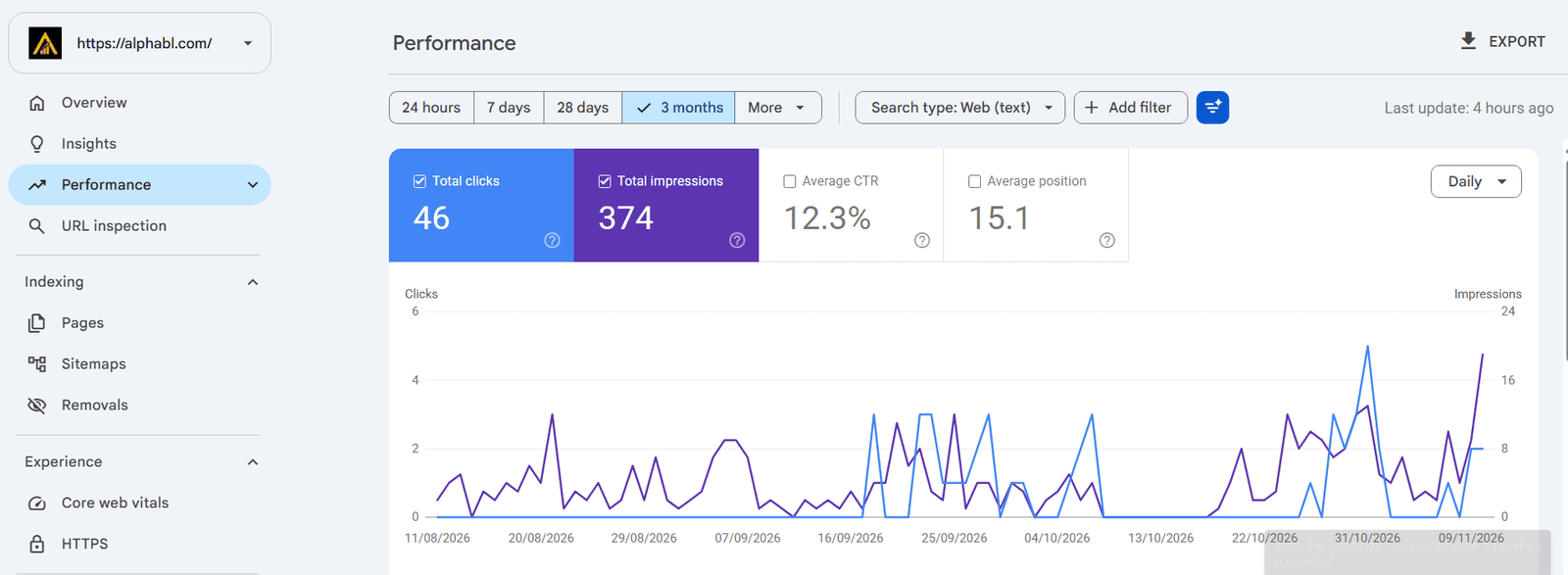
You still need Ahrefs, Semrush, or Google Search Console for that.
Use AI to organise and expand the data you already have.
Where Each Tool Helps
ChatGPT is handy for fast brainstorming of long-tail variations and search intent.
Claude is stronger when you paste a large keyword export and want it grouped into topic clusters.
Since both can search the web now, ask them to check what currently ranks before you commit to an angle.
Also ask for the follow-up questions a reader would have after finishing the top result.
Those questions make strong H2 and FAQ ideas.
Urdu, Roman Urdu and Local Search Queries
Competitor articles ignore language completely.
For a business in Lahore or Sialkot, many searches are typed in English, Urdu, or Roman Urdu.
Ask both tools for query variations in all three, then check each one against Google autocomplete.
Have a native speaker review the final list.
Machine-generated local phrasing can sound slightly off, and that costs clicks.
A Prompt Pattern That Works
Paste your keyword export and write: “Group these into search-intent clusters. Name each cluster, mark the main keyword, and flag any queries that need their own page.”
Technical SEO: Schema Markup and Content Audits
Schema Markup
One widely quoted SE Ranking test found fewer validation issues in Claude’s schema than in ChatGPT’s.
That test used older models, so treat it as history.
The safe habit works with any tool.
Generate the JSON-LD with either one, then validate it in Google’s Rich Results Test before it goes live.
Content Audits and the Context Window
A bigger window helps, but it does not think for you.
Claude can take around a million tokens, so an entire site section fits in one conversation.
ChatGPT Plus has a smaller window, so split large audits into batches of 30 to 50 pages.
In both cases, give the model a table with URL, title, H1, word count, and Search Console clicks.
Without that data, it can only guess which pages are thin or competing.
ChatGPT vs Claude for SEO: Which Tool for Which Task?
Here is the short version of ChatGPT vs Claude for SEO, organised by job.
| SEO task | Better first pick | Why |
|---|---|---|
| Long-form first draft | Claude | Holds long briefs and structure well |
| Title and meta variations | ChatGPT | Punchier options |
| Keyword clustering from a big export | Claude | Very large context window |
| Quick topic brainstorming | ChatGPT | Fast and cheap, even on free |
| Live SERP research | Either | Both can now search the web |
| Schema markup | Either, then validate | Google’s test decides |
| Large content audits | Claude | Fits more pages per chat |
| Blog images | ChatGPT | Built-in image generation |
Treat this table as a starting point, not a verdict.
How to Test Both Tools on Your Own Site
Benchmarks cannot tell you what works for your niche.
A small experiment can.
Pick three tasks, such as a blog draft, ten meta descriptions, and a keyword cluster.
Run the same prompt on both tools.
Then score each result on accuracy, structure, originality, and editing time.
Editing minutes per 1,000 words is the number I trust most.
It captures the real cost of a draft, and no detector can give it to you.
A Practical SEO Workflow Using Both Tools
This is how I would run ChatGPT vs. Claude for SEO inside a single project.
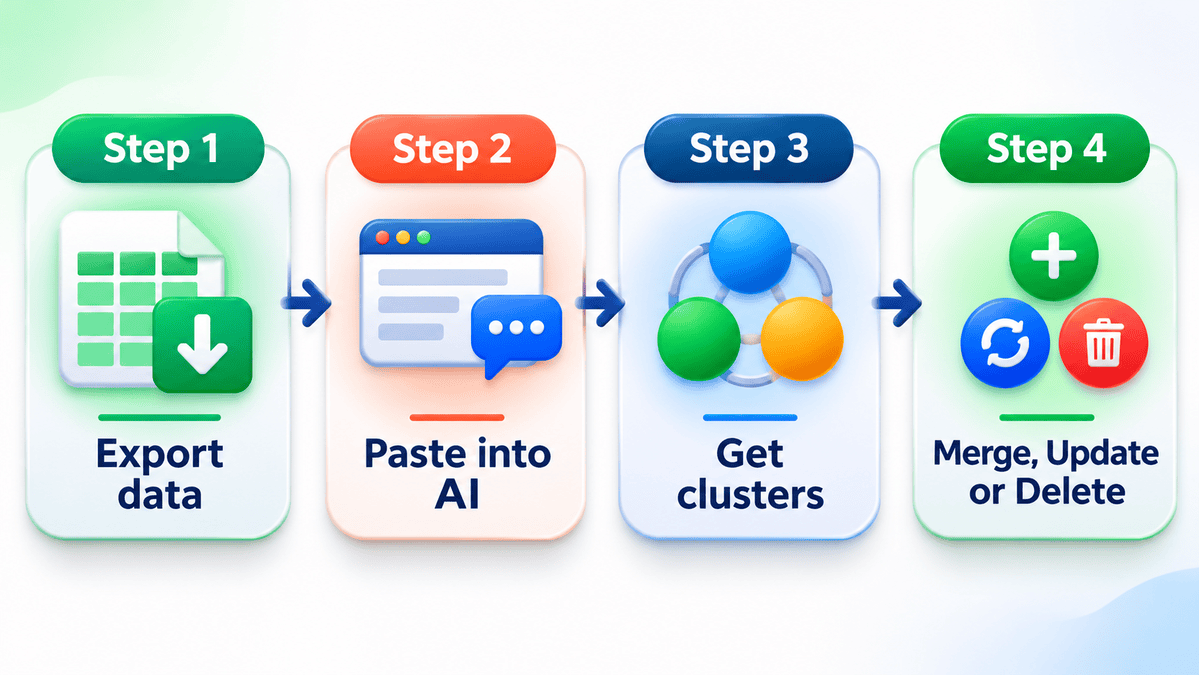
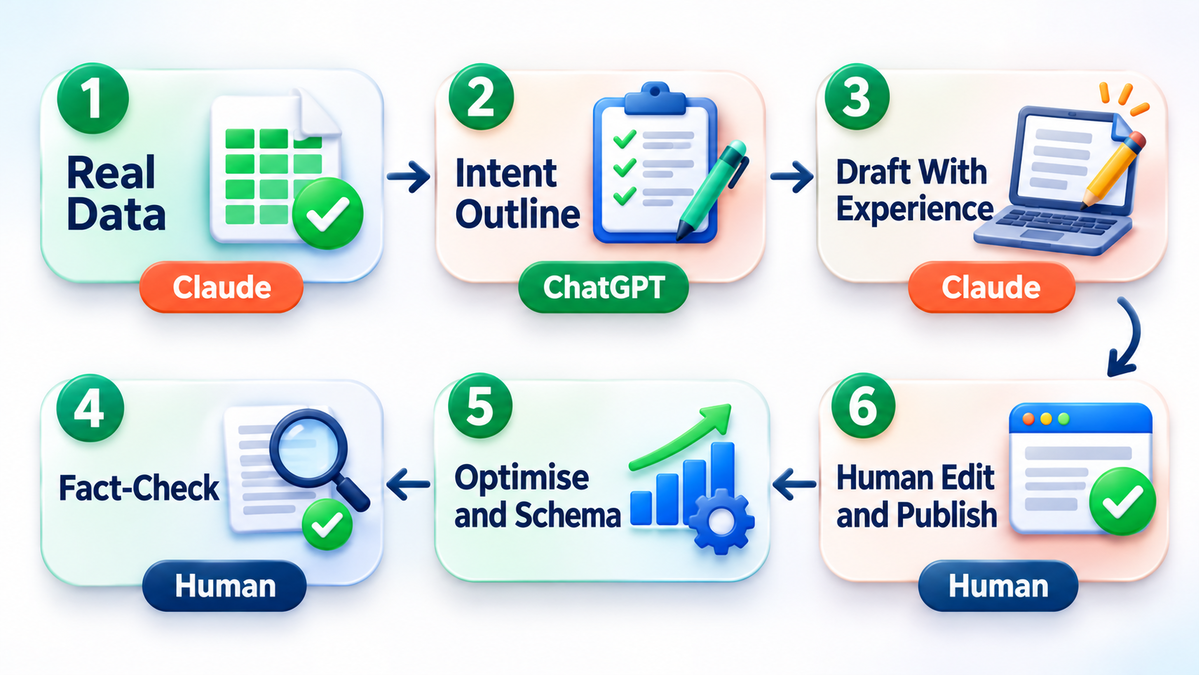
Step 1: Start With Real Data
Export queries and pages from Search Console.
Paste them into Claude and ask for clusters and content gaps.
Step 2: Build the Outline Around Search Intent
Ask ChatGPT to search the current top results and list what they cover.
Then list what they miss.
Those gaps become your information gain.
Step 3: Draft With Your Own Experience
Give Claude the outline, your style guide, and three real examples from your work.
The examples are what make the page yours.
Step 4: Fact-Check Every Number
Models can sound confident while being wrong.
One practitioner who ran both tools for seven weeks described plausible answers that failed when checked against the source.
Verify each statistic, price, and date against the original page.
Step 5: Optimise and Add Schema
Write the title tag and meta description, add FAQ schema, and validate it.
Check that the title tag, the H1, and the first paragraph all point to the same primary keyword.
Step 6: Edit as a Human, Then Publish
Read the page aloud.
Cut every sentence that does not help the reader.
Common Mistakes That Waste Your AI Subscription
Asking AI to Rewrite Competitors
Rewrites carry zero information gain.
Google already has the original.
Skipping Answer-Engine Formatting
Search now includes AI Overviews and chat answers.
Put a direct two-to-three-sentence answer under each question heading, and name your sources.
That structure helps both readers and answer engines pull a clean passage.
Publishing Without Real Experience
Google’s quality guidelines value first-hand experience.
AI has none, so you must supply it.
Add a client result, a screenshot, a failed test, or a number from your own account.
One honest detail from real work beats three paragraphs of polished general advice.
Judging by One Prompt
One prompt proves nothing.
Run the same task three times on each tool and compare the results.
Which Plan Should You Buy?
Start free.
Free ChatGPT and free Claude are both strong enough to test this whole workflow.
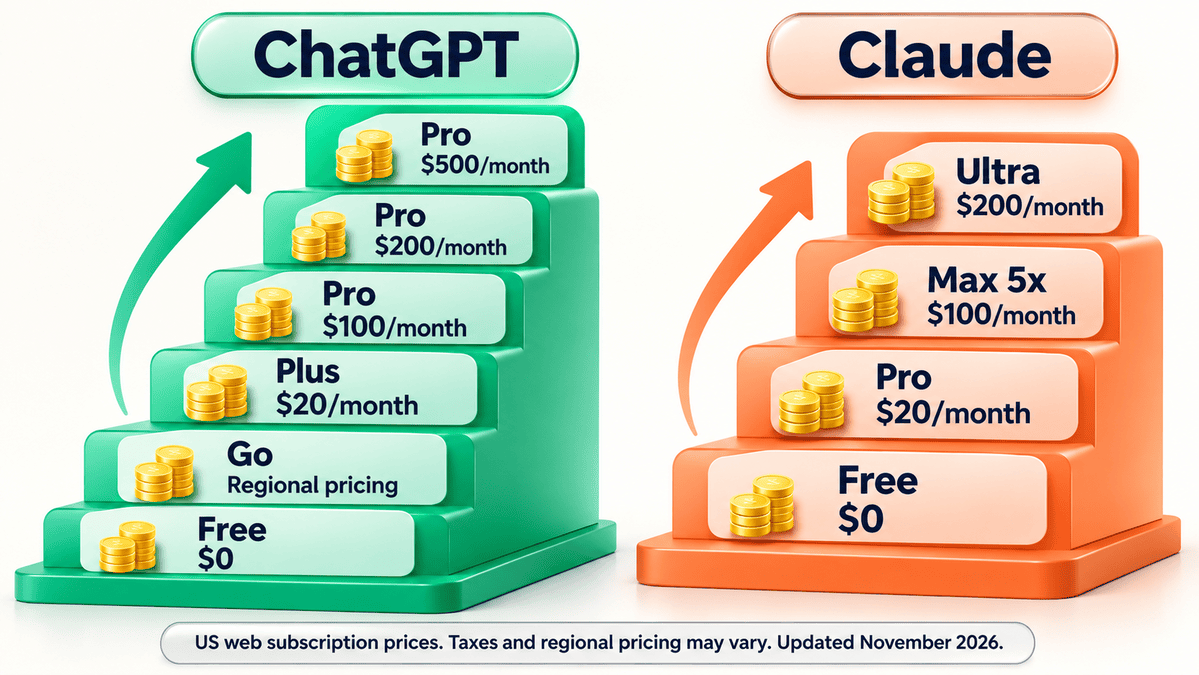
When you outgrow them, Claude Pro and ChatGPT Plus both cost $20 a month, so the combined price is $40.
Heavy users can step up to Claude Max at $100 or ChatGPT Pro at $100.
Agencies should compare usage limits first, because plan caps change often.
What Should a Beginner Pick?
If you publish fewer than ten articles a month, one paid plan is enough.
Choose Claude if most of your work is long articles and audits.
Choose ChatGPT if you also need images, quick copy, and general marketing help.
Add the second tool only when you notice yourself hitting a limit.
Need Expert SEO Help? Work With AlphaBL
AI speeds up the work, but strategy still needs a human who understands your market.
AlphaBL is an SEO agency that combines smart tools with manual research, on-page work, and technical fixes.
If your business is in Punjab, explore our SEO Services in Lahore or work with an SEO Expert in Sialkot.
We will audit your site, find the gaps competitors missed, and build a measurable plan.
Get in touch today and let’s talk about your SEO goals.
Final Thoughts
The debate around ChatGPT vs. Claude for SEO is less about a winner and more about fit.
The tools have changed a lot since March, so any comparison older than a few months deserves a retest.
Use Claude where long context and structure matter, use ChatGPT where speed matters, and use real data everywhere.
Verify facts, add your own experience, and publish something competitors cannot copy.
Pick one task this week, run it on both tools, and keep the one that gives you better pages.
Frequently Asked Questions
Is Claude better than ChatGPT for SEO in 2026?
Neither wins every task.
Claude tends to lead on long drafts and large audits, while ChatGPT is quick for brainstorming and short copy.
Most professionals use both.
Which tool writes more natural content?
Many editors prefer Claude’s long-form prose, but results depend on your prompt and examples.
Whatever you use, add your own experience and edit by hand.
Can they give me search volume or keyword difficulty?
No.
Use Google Search Console, Ahrefs, or Semrush for metrics, and use AI to organise them.
Does Google penalize AI-written content?
Google says it evaluates content on helpfulness and quality, not on how it was produced.
Thin, unoriginal pages are the problem, whoever writes them.
Can I use both tools for free?
Yes.
Both offer free plans with web search and chat, which is enough to test your workflow.
Which one has the larger context window?
Claude offers about one million tokens.
ChatGPT’s window is smaller on Plus, so split big audits into batches.

Habib Ur Rehman is the Founder and CEO of Alpha BL, specializing in Digital Marketing and SEO.